

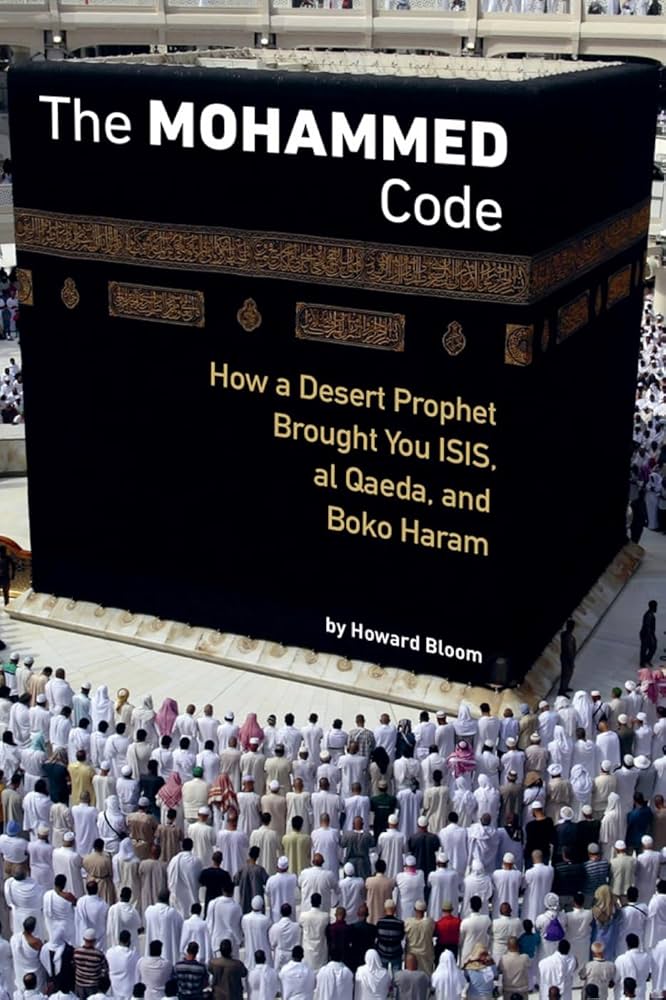
Howard Bloom’s “The Mohammed Code”: A Controversial Lens on Modern Conflict and the Iran Crisis
-
- April 23, 2026

In times of global tension, ideas often become as powerful as weapons. As the world watches escalating instability involving Iran and the broader Middle East, one controversial work continues to surface in discussions of ideology and conflict: The Mohammed Code by Howard Bloom.
Bloom’s thesis is bold and deeply debated. He argues that to understand modern militant movements and geopolitical tensions, one must examine early Islamic history—not just as religion, but as a system that once fused faith, politics, and warfare. Drawing from classical Islamic texts, Bloom portrays the Prophet Muhammad not only as a spiritual leader, but as a military and political strategist whose legacy, he claims, continues to influence extremist interpretations today.
In Bloom’s view, groups ranging from ISIS to other militant factions—and even elements within state power structures—draw ideological inspiration from historical precedents of expansion and conquest. He suggests that this historical framework shapes how certain actors perceive conflict, victory, and global influence.
This is where his work intersects with current tensions involving Iran.
Iran is not a monolith, but it is a nation where religion and governance are intertwined. Bloom highlights how revolutionary ideology—especially since the rise of figures like Ayatollah Khomeini—has, at times, invoked religious narratives tied to struggle, resistance, and power. According to Bloom, ignoring these ideological dimensions can lead to a shallow understanding of conflicts that are not purely political or territorial, but also philosophical.
However, this perspective is far from universally accepted.
Many historians, political analysts, and Islamic scholars reject Bloom’s framing as overly reductive and controversial. They argue that it conflates extremist interpretations with the beliefs of over a billion Muslims worldwide and overlooks the complex political, economic, and historical factors that drive modern conflicts. Issues such as regional power struggles, sanctions, foreign policy, and historical grievances are widely considered far more immediate drivers of tensions involving Iran.

Still, Bloom’s work persists in conversations because it attempts to answer a difficult question: Are modern conflicts purely about power—or are they also shaped by deeply rooted narratives that span centuries?
Whether one agrees with him or not, The Mohammed Code forces readers to confront the role of ideology in global conflict. In an era where wars are fought not only on battlefields but in belief systems, that question remains impossible to ignore.
The real challenge is not choosing one explanation over another—but understanding that today’s conflicts are layered, complex, and shaped by far more than a single theory.
The official website for Howard Bloom may be found at https://www.howardbloom.net