

Randy Edelman: The Composer Who Stepped Into the Light
-

- May 7, 2026
There is an unwritten rule in film scoring: stay invisible. Write the music that moves the audience, then step aside and let the picture take the credit. For decades, Randy Edelman followed that rule masterfully — and then, deliberately, he broke it.
While most composers of his caliber remain permanently behind the curtain, Edelman has spent recent years doing something his peers rarely attempt: performing. Not in the controlled environment of a recording session or a scoring stage, but live, in front of audiences, on some of the most storied stages in the world. Carnegie Hall. Lincoln Center. The Grand Ole Opry House. Sold-out rooms where the music has nowhere to hide and neither does the man who wrote it.
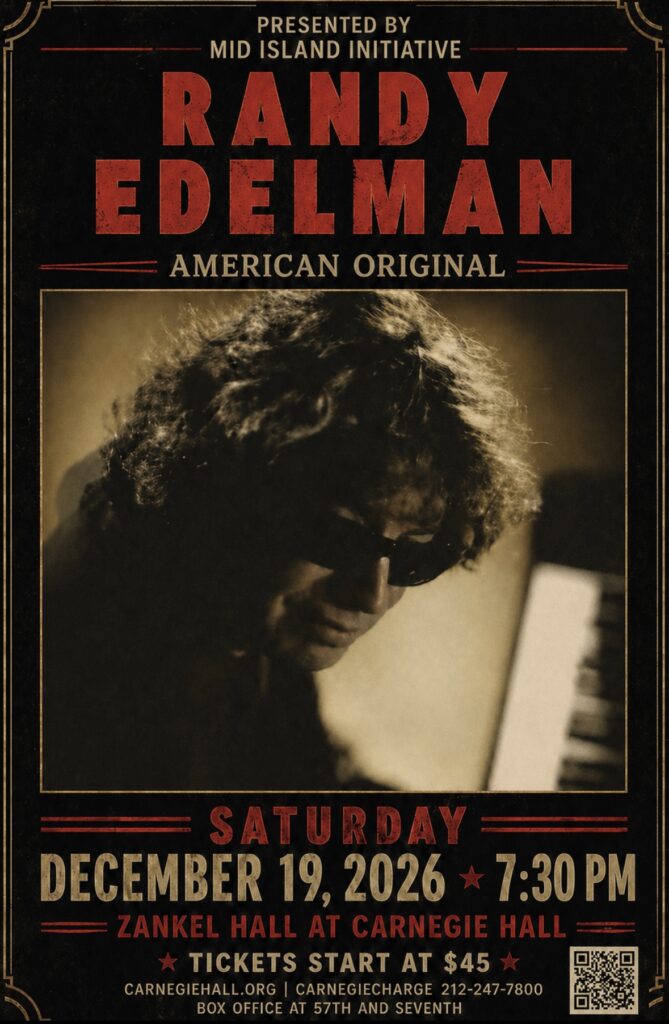
The results have been extraordinary. Audiences who came knowing the music — the sweeping themes from The Last of the Mohicans, the bold emotional architecture of Gettysburg, the warmth threaded through Kindergarten Cop and The Mask — discovered something they didn’t expect: the composer himself, present, generous, and wholly alive in performance. His live show, built on music, song, and story, collapses the distance between the screen and the stage in a way that no documentary or retrospective ever could.
This is the Randy Edelman that the film world never fully showed you. The songwriter who wrote “Weekend in New England” for Barry Manilow and “Isn’t It a Shame” for Patti LaBelle. The pianist who came up playing Broadway pit orchestras, who toured as a music director, who built a pop catalog that found devoted audiences across the UK, Europe, and Japan before Hollywood ever came calling. Performance was never foreign to him. It was, in fact, where he began.
Now it is where he is headed again — and on December 19, 2026, that journey arrives at its most powerful destination yet. Edelman returns to Carnegie Hall for the third time, a milestone that places him in extraordinarily rare company. Three appearances at one of the world’s most demanding concert venues is not a gesture toward legacy. It is legacy, actively being written.
What Edelman has understood — and what his Carnegie Hall run makes undeniable — is that the composer and the performer were never two different people. They were always the same artist, waiting for the right stage.
On December 19, he’ll have it again.